A year ago, in April 2025, I ran the TCS 10K in Bangalore. Time: 1 hour, 24 minutes.
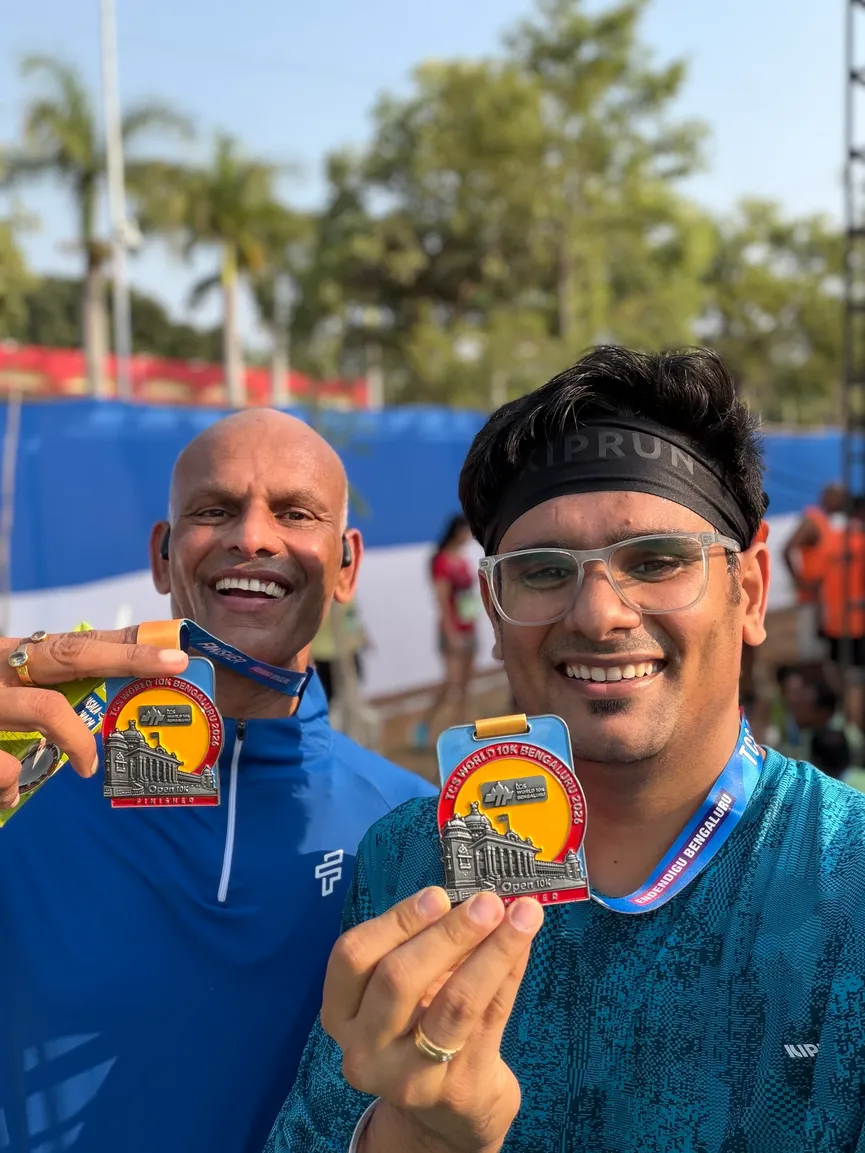
Today, I ran the same race. 1 hour, 2 minutes at a pace of 6 minutes 13 seconds per kilometre. Twenty-two minutes faster than the same race a year ago.
Same body — except not really. Lighter. A fitter heart. A faster pace at lower effort.
The shortest version of how that happened: I had a coach. The coach was AI.
Let me explain what that actually looked like.
It’s Not Just the Running. It’s the Weight.
You can’t out-run a heavy body.
I ignored this for a long time. I thought if I ran more, the speed would come. It does, a little. But the real unlock was weight. Over the last 2 months, I dropped close to 6 kilos.
Every kilo gone meant my heart didn’t have to work as hard at the same pace. The same 5K that used to spike my heart rate into Zone 4 started settling in Zone 3. Then Zone 2. Without changing anything about how I ran — just by being lighter.
Two weeks before the TCS 10K, I ran a 5K personal record outdoor — 30:34 at Cubbon Park. That wasn’t because I trained harder that week. It was because the body running the 5K weighed less.
The food and the running weren’t two separate projects. They were the same project.
Mukesh and the Sunday Run
I run three times a week — around 21 kilometres total. Two of those are solo treadmill runs in my apartment gym. Predictable, easy logistics, no excuses.
The third is Sunday outdoor with Mukesh.
I’ve written about Mukesh before from the Dubai half marathon. He’s 50+, an elite runner, and the kind of person who shows up no matter what.
He showed up every Sunday. Cubbon Park, 6 AM. We ran our own paces, but we started together. It’s harder to skip a run when someone is waiting for you. It’s easier to push when your partner is pushing himself.
The journey was mine. But the partner made it repeatable.
Claude as My Coach
The other piece of the system was an AI coach.
Specifically, Claude.
What made it work was that I didn’t just chat with it. I built it into a Claude Skill — a small piece of context that loaded my profile every time I started a conversation. The Skill knew my weight, my baseline heart rate, my HRV, my work schedule, my Ekadashi fasting days, my gym routine, my family routine, and my race goal.
That’s the difference between asking AI a one-off question and having an ongoing coaching relationship. A new chat starts blank. The Skill remembered everything — my last run, my last weigh-in, my last Ekadashi day.
So when I’d send a screenshot of a tough Thursday interval session, the response wasn’t “looks like a hard run.” It was “your HRV was 33 yesterday, you’re on 4 hours of sleep, this was hard because you’re under-recovered. Move legs day to Friday next week.”
That’s a coach.
The Screenshot Rule
One small thing I was deliberate about — I sent screenshots of my Apple Fitness Activity, not Strava API data through some MCP integration.
It felt less automated. More boring. But the screenshots carried way more — HR zone curves, post-run recovery, cadence trends, full split tables. The API would have given me automation. The screenshot gave more data.
Quality over automation.
The Boring Discipline — Logging
This part isn’t glamorous.
Every run day, I logged the run. Every meal day, I logged the food — even the ones I wasn’t proud of. The Toscano dinner. The pizza at Pizza4Ps. The ice cream at Milano.
Not for the AI. For me.
The point of logging wasn’t that the AI needed it. It was that I started seeing patterns I’d miss otherwise. The “just a bite” drift at restaurants. The 3 PM boredom snacking on Fridays at home. The dip in HRV after late nights. None of those would have been visible to me without writing them down.
If you’ve read my Consistency blog, this is the same idea — keep it simple, keep it repeatable. Logging takes 60 seconds. I did it on run days. Over 10 weeks, those 60-second entries told a story that no single run could.
What the Data Showed
In February, my easy treadmill run was at speed 8 — a pace of 7 minutes 30 seconds per kilometre. My average heart rate sat at 136. It felt like work.
By late April, speed 9 — a faster pace, 6 minutes 40 seconds per kilometre — was my easy. My average heart rate at that speed was 142. It felt comfortable.
At a faster pace, my heart rate was only 6 beats higher than the slower one in February. At the same pace as February, it would have been lower.
The same story showed up at higher speeds. In late March, my tempo at speed 10 (6 minutes per kilometre) had my heart rate at 149. By early April, the same speed 10 had me running at 145. Four beats per minute lower, at exactly the same pace, in two weeks.
What used to be my tempo pace became my warmup. What used to be intervals became my tempo.
That’s what training plus weight loss does, given time.
What AI Did, and Didn’t Do
What it did:
- Caught patterns I’d miss in the noise
- Gave honest, data-grounded analysis after every run
- Held me accountable when I drifted (and I drifted plenty)
- Predicted my race day pace, fueling, and heart rate with surprising accuracy
What it didn’t do:
- Run for me
- Eat for me
- Wake up at 4:00 AM on race day
- Hold my pace at kilometre 6 when I wanted to stop
- Show up at Cubbon Park at 6 AM on Sundays — that was Mukesh
The coach helped me think clearer. The running, the eating, the showing up — that was always mine.
What I’d Tell Anyone Trying This
If you want to try AI as a coach, don’t make it complicated:
- Build a profile. Tell it about your body, your schedule, your family, your goal. Save it somewhere it can read every time. (For me that was a Claude Skill.)
- Log honestly. It can’t help you if you lie about the chocolate.
- Send screenshots. They carry more than API numbers.
- Ask “what am I missing?” more than “what should I do?”
That’s it. No app to download. No subscription. No fancy setup. Just consistent honest logging and a coach that remembers what you told it last week.
Closing
3 runs a week. ~6 kilos lighter. Honest logging. A coach that never forgot a number. And Mukesh on Sundays.
That was the formula. Nothing fancy. Just repeatable.
The medal from TCS 10K is mine. The 6:13 per kilometre race pace is mine. The 6 kilos came off because I made boring choices for 10 weeks.
The AI just helped me see clearly.
