
For a long time, I believed the next step after becoming a strong Senior Engineer was simple — write better code, design bigger systems, and mentor more people.
In reality, the transition to Tech Leadership was far less about technical depth and far more about decision ownership, ambiguity, and people energy.
This isn’t a “how to become a leader” guide. This is what actually changed for me — mentally, professionally, and personally — over the years.
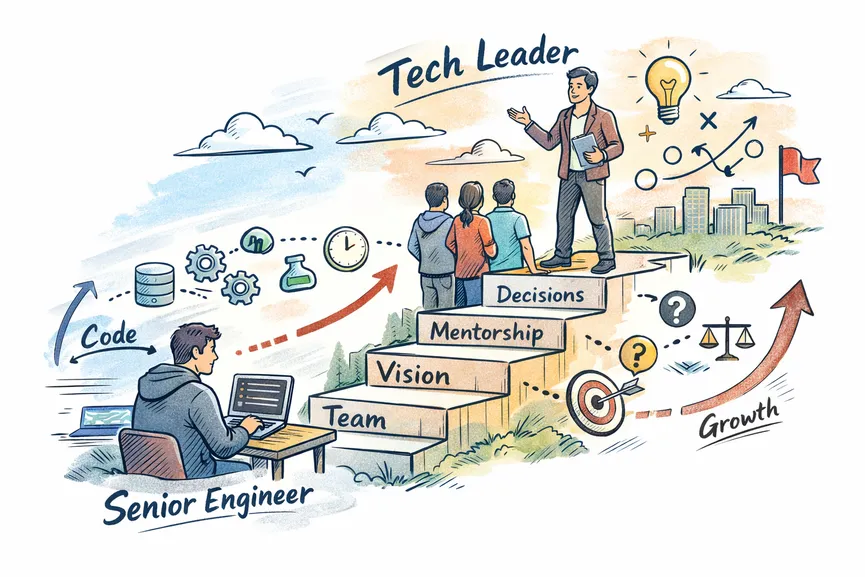
The Day Your Output Is No Longer Code
As a senior engineer, your impact is visible:
- PRs merged
- Services shipped
- Performance improved
- Bugs fixed
As a tech leader, your impact becomes invisible.
Your output becomes:
- Decisions others execute
- Clarity others operate in
- Systems that scale beyond your involvement
- People who grow faster because of your direction
This was the hardest shift for me.
There’s a strange discomfort when you realize:
The best week of leadership sometimes looks like “I didn’t write any code”.
Earlier, that would feel like underperformance. Now, it often means I was solving the right problems.
You Stop Optimizing Code. You Start Optimizing Systems (And People)
As an engineer, I optimized:
- Latency
- Cost
- Query performance
- Deployment speed
As a leader, I optimize:
- Decision latency
- Team cognitive load
- Communication clarity
- Architectural direction
- Psychological safety
A slow system can be fixed with engineering effort. A slow decision culture can block an entire organization.
You Live With Ambiguity — Daily
As an engineer: You usually get a defined problem.
As a tech leader: You are often defining the problem itself.
Examples I deal with regularly:
- Is this even the right product direction?
- Are we solving the right problem for the business?
- Should we invest in this platform capability or kill it?
- Is this team structure helping or hurting delivery?
Nobody gives you clean tickets for these.
And honestly — this took me time to get comfortable with. Engineers are trained to reduce uncertainty. Leaders operate inside it.
You Make Decisions With Incomplete Information (And Own Them)
One of the biggest mindset shifts:
You rarely get 100% clarity before making decisions.
Instead, you learn to:
- Identify reversible vs irreversible decisions
- Decide fast where possible
- Go deep where it matters
- Accept that some decisions will be wrong
Earlier, I optimized for correctness. Now, I optimize for directional correctness + speed.
Your Job Is Not to Be the Smartest Engineer in the Room
This was a subtle ego adjustment.
Earlier: My value = how well I could solve hard problems.
Now: My value = how well I can create an environment where others solve hard problems.
And honestly, the best feeling now is: Seeing engineers I mentored make decisions I didn’t even think of.
Mentorship Stops Being Optional
As a senior engineer, mentorship is something you do.
As a leader, mentorship is something you are.
You are always:
- Setting tone
- Setting standards
- Setting behavioral patterns
- Setting learning culture
People don’t just follow what you say. They follow what you consistently do.
Communication Becomes Your Primary Technical Skill
I used to think architecture diagrams and code were my main tools.
Now it’s:
- Writing clearly
- Explaining tradeoffs
- Aligning stakeholders
- Translating business → tech → execution
- Saying “no” without killing momentum
You realize: A well-written message can unblock weeks of engineering confusion.
You Start Thinking in Years, Not Sprints
As engineers, we think: Next release. Next sprint. Next feature.
As leaders, you think:
- Where should this platform be in 2 years?
- Are we building something teams can live with long term?
- Are we creating accidental complexity?
You trade short-term satisfaction for long-term clarity.
The Emotional Load Increases (But So Does Meaning)
No one talks about this enough.
You start carrying:
- Team morale
- Hiring quality
- Stakeholder trust
- Incident pressure
- Long-term tech direction
But the upside is huge.
You stop shipping features.
You start shaping how things get built.
And that is incredibly fulfilling.
The Most Unexpected Change: Energy Management > Time Management
Earlier: If I had time, I could do the work.
Now: If I don’t have mental clarity, I can’t make good decisions.
This is where things like:
- Fitness
- Routine
- Focus blocks
- Reducing context switching
… stopped being “nice to have” and became leadership tools.
What I Wish I Knew Earlier
If I could tell my Senior Engineer self something, it would be:
- Your value will shift from execution → direction
- Communication is a force multiplier
- Not every problem should be solved by you
- Speed of clarity matters more than perfection
- Growing people is the highest leverage work you can do
Final Thought
Becoming a tech leader is not about moving away from engineering.
It’s about expanding the definition of engineering:
- Engineering systems
- Engineering teams
- Engineering decision environments
- Engineering clarity
And if you still love technology deeply — You don’t lose that.
You just apply it at a different layer.